


- Coal
- Mow Cop Colliery
- Engineers Plans
- The Tunnel
- Falls Colliery
- Williamsons
- Rail Track
- Map 1890
- Map ofTramway
- Harriseahead Coal
- Astbury Lime Works

Coal Mining & The Tramways
Coal mining has been one of the main influences in the development of Mow Cop. Unlike the stone quarrying though, the evidence of this industry is quite well hidden. There are no relics like pit headgear lying about, or large waste heaps, however once you know where to begin looking, the evidence is still physically there. The coal mines were initially basic and primitive shallow workings, usually on farmland, or even as in the case of Stone Trough Colliery, in the farm yard itself. They were mined seasonally, once the crops had been taken care off, and all the rest of the spring and summer work was complete, the farm workers would then become miners, descending down ladders, and using buckets and pulleys to bring the black gold to the surface.
In the early 1800’s a railway was built from Stone Trough Farm to the coal wharf at Congleton Moss. The track went up what is now Towerhill road and turned right along Congleton road. It then descended down to Congleton Moss for the purpose of supplying coal to Congleton. Stone Trough Colliery had a chequered past, in 1810 John Johnson leased the colliery to William Glover for 25 years. Johnson had been made bankrupt in 1807, it is during this period the mine remained un-worked.
C.F.Dendy Marshall wrote in 1830 …On the south-east of Congleton in Cheshire, abut 2 miles at the north-west corner of Congleton Moss, a cola yard was established about the year 1807, for the supply of this town and a Rail-way was laid there. From the south about 2 miles to Stonetrough Colliery in Wolstanton. It was laid with oval bars of iron, on the top of which the pulley formed wheels of the tram ran; but when I saw this Rail-way in July 1809, it seemed to be almost quite disused.
The track was oval in shape and was made of cast iron. It was similar to the rails used on the Penrhyn Railway in 1801. That was designed by Benjamin Wyatt of Bangor. Stone blocks formed the sleepers and can be seen on the embankment above the lime works at Astbury. Judging by the width of the embankments we can also assume that the tramway was 2ft gauge. The track was oval (egg shaped) and the wheels resembled pulleys that could easily sit on the oval track. The tramway crossed over what is now Ganny bank on a bridge; again the embankments are still there. The route of the tramway is now a footpath, and is clearly sign posted.
In 1831 there was an
advert in the Staffordshire Advertiser.
“to be let on the
most advantageous terms. The coal is very superior quality adapted to Engines,
Brewers Bakers etc. and is well known in the Macclesfield Market. The colliery
is stocked with engines, wagons etc, with a line of Railroad nearly all the
way to Congleton Moss…”
An agreement was also
reached in 1832 between Randle Wilbraham and the Rev. William Moreton (Lords
of the Manor at Odd Rode) and John Hall the coal miner and current lease holder
of Stonetrough Colliery, to lease a piece of land.
Extract of the lease
`…for the purpose
of forming a railway to lead form the coal works of the said parties called
the Stonetrough Colliery toward the Macclesfield canal, at a point a little
north of the place where the same is crossed by the road leading from Kent
Green to Old House Green…
- Limeworks Video
- Tunnel
Video
The Tunnel is now sealed and is on private property. there is no public access.
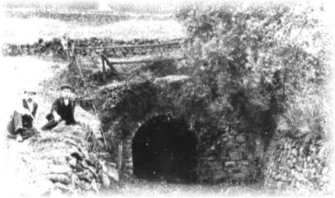
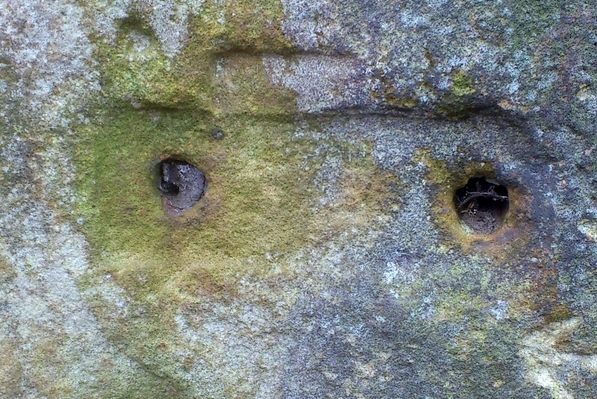
It has been estimated that there were 7000 stone sleepers used, however
wooden sleepers were used inside the tunnel
Later that year the fifty year lease for
Stone trough and Towerhill farm was handed to Robert Williamson who then sunk
pits at Towerhill Farm, and re opened Stonetrough which had not been mined
for 4 years. By 1838 an agreement was
reached between The Macclesfield Canal Company and Williamson to allow the
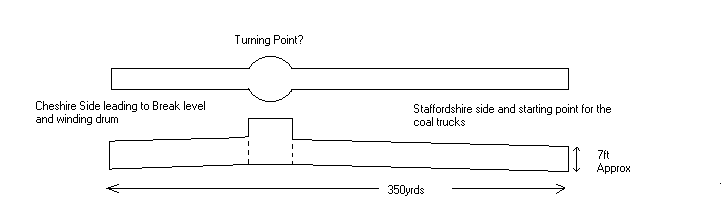
railway to be built. This new railway and tunnel took 6 years to construct.
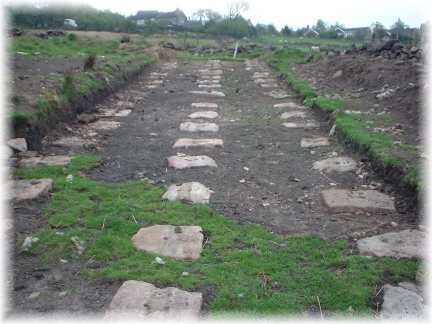 Excavated sleepers
at the top of the brake incline
Excavated sleepers
at the top of the brake incline
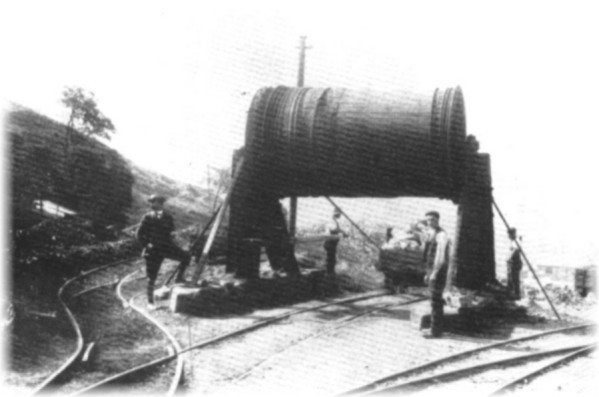
Brake Winding Drum at Froghall, maybee like the one at Mow Cop
As the mining industry grew in the 1830’s
and 40’s miners from other parts of the country settled here. The main influx
came from
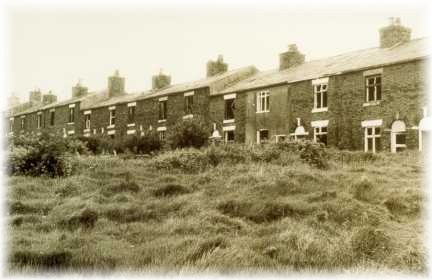
Welsh Row
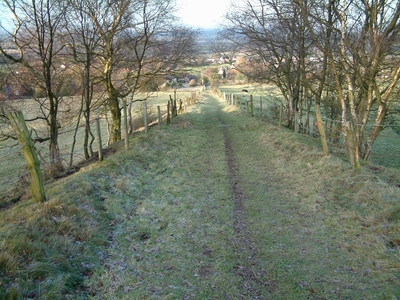 View down the Brake Incline
Robert Williamson’s sons, Hugh
Williamson and William Shephard Williamson were both getting
coal from out of Stonetrough colliery 3 years after the expiry of the lease,
and in November, 1886, they filed for bankruptcy with liabilities exceeding
£50 000. The freehold of the two collieries went for auction and was purchased
by Robert Heath. Heath immediately closed the pits and in July
1887 pulled up the rail tracks; this was to boost his already successful mining
and steel empire in Biddulph.
