|
                         
 
|
|
 |
|
|
|
 |
|
Wells |
|
|
|
|
|
|
|
|
 |
|
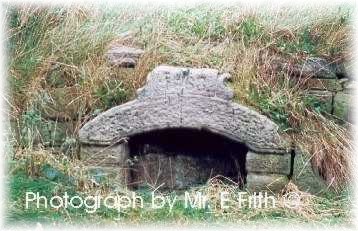
There
has been as long as the hill itself an abundant supply of water on Mow Cop,
even now I can count 3 covered reservoirs that supply both Staffordshire and
Cheshire. In the past however there were many more water sources. I have studied
an old map of the area from the turn of the century and have counted at least
30. Most of these are not wells in the sense of a large walled pit descending
into the ground; they are natural springs that have been built around, or a
simple pipe allowing access to the clear God sent liquid.
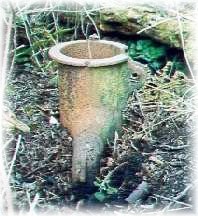
One of the first curiosities I have found is the remains of a water pump partly covered in the wall of Castle Road, just up from
the Mow Cop Inn. It is clearly visible where there was a recess in the wall,
and just above it protrudes the trunk of a water pump. |
|
|
|
|
|
|
 |
|
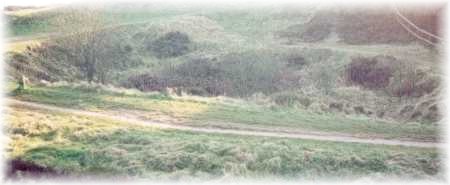
The Sugar Well
was at the back of the castle and was said to be 70ft deep. The only remains
of the well are a large bowl like indentation in the ground.
This was once walled and was
built at the same time as the castle to supply
the Wilbraham family as they visited their summerhouse
|
|
|
|
|
|
 |
|
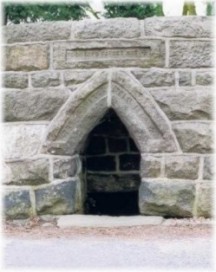
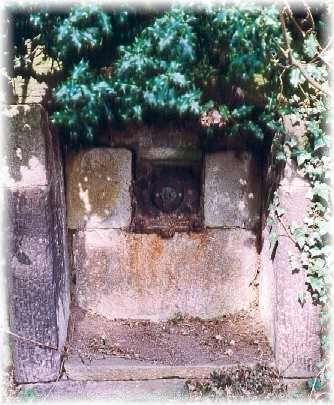
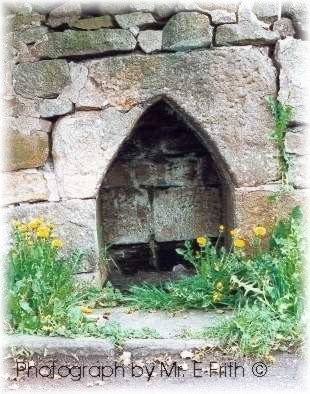
The most impressive looking of the
wells however are the `Squire’s Well’ and the `Parsons well’.
These were built up almost like shrines and are very good examples of
just how much the people of Mow Cop respected the water supply that they
had. For many years well dressing was common , but this tradition has
long since ended.
The Squire’s
Well (left) bears the inscription
"To do good forget not"
"The Squire’s Well 1862"
|
|
|
|
|
|
|
|
|
 |
|
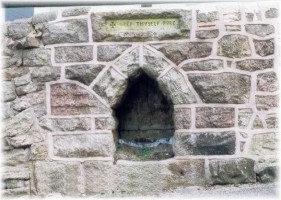
"The Parsons Well, 1862"
This was the built the same
year that the Primitive Methodist Memorial Chapel was built and was apparently
funded by Miss Wilbraham. An Ode to this fact was written by Mr David Oakes
"Mrs Wilbraham is a Lady born
All other women she doth excel
Twenty guineas she did lay down
For making Parsons Well." |
|
|
|
|
|
|
|
|
|
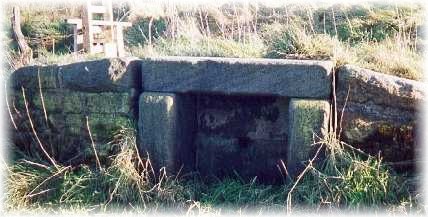
The
Corda Well this can be found on the path that was the Tramway
of 1807. This is the one well that never ran dry and still flows to this
day. During droughts and very hot summers, when all the other wells had ran
dry the Corda Well kept flowing, and people came from many miles at all times
of day and night. Lord Egerton leased the Corda to the Congleton Water authority
at the turn of the 20th century. The water was piped underground
to the Corda Well Tank in Newbold and from there fed to the Congleton Moss water
tower. The location of the Water Tank can be seen on the 1908
map. As you walk through the fields between The Corda Well and the Old site
of Congleton Water Corporation, you will come across ½ dozen or so covered
inspection shafts. The 1st is right by the Corda Well and is a the old cistern,
the next is 100 yards down in the swampy ground, and has filled up due to a
blockage. The covers and the water works are on land owned by Limekiln Farm
at Astbury Lime Works. Until 1998 this spring water as part of the agreement
fed this farm and 3 houses in the same region. As the pipes deteriorated it
became uneconomical to continue with this water supply. |
|
|
|
|
 |
|
|
|
|
|
|
|
|
|
|
|
|
|
|
|
|
|
|
 |
|
|
|
|
|
|
|
|
|
|
|
|
|
 |
|
|
|
|
|
 |
|
|
|
|
|
|
|
|
|
|
|
|
|
|
|
Towerhill Well |
|
|
|
|
|
Well Street |
|
|
|
|
|
|
|
|
|
|
The
Waywarden’s Well was removed and re assembled near to Mow Cop Station
in 1905. It has now dissapeared completely. |
|
|
|
|
|
|
|
|
|
|
|
|
|
|
|
|
|
|
|
|
|
 |
|
|
|
|
|
|
|
|
|
|
|
|
|
|
|
|
|
|
|
|
|
|
|
|
|
|