
Stone Quarries
The original quarrying of stone would have been a simple affair, individuals who required a quern or stone for some other reason, would have paid a small fee to the local land owner for the right to fashion a stone.
Later in the 13th century it became more lucrative, with the ownership of the Staffordshire side of Mow belonging to the Manor of Tunstall. In fact the combined revenues for the Manor of Tunstall from Mow Cop quarries was more than the combined income of the other industrial operations such as coal and iron mining.
The following is an extract from "Strange News of Staffordshire", which was printed in 1642. The spelling remains unchanged.
At a place neer the common great road betwixt London and Manchester in Staffordshire, called Moule Cop, in the English Maps, but in the old Saxon language Hiperbolian Talke, which is a large hill in English, as Talke of the Hill which signifies a bush on a Hill: Mow this Moule Cop Hill is a vast sublime place very mountainous and devious no common passage over it, but carriages have happened to come thither for millstones and grinding stones, which now are not there to be gotten, by reason to Lords of that soyle are at strife and variance there, about contesting for the seigniory. This hill is four or five miles from the top to the bottome, and on the top is a large plain, wherein those millstones have beene gotten out: And the place where the great quarries were, and in depth ion the hill top four score yards, and in length and latitude a hundred yards round each way; And over the top of that Hill goeth a straight line which divideth Staffordshire and Cheshire assunder.
It was during the 17th century
that the quarried rock was pounded into fine white almost pure quartz. This
was added to Staffordshire potters clay to improve the colour and hardness
of the pottery. Gilbert Wedgwood, who left his family home on Mow Cop to set
up as a master potter in Burslem in 1616, possibly started this. Women and
children pounded the stone, and then using mules transported the sand to the
towns.
It was during the 18th and 19th century that quarrying
became big business on Mow Cop, the following are quotes from advertisements
found in the "Staffordshire Advertiser"
- STONE FOR ROAD MAKING. "the stone must be broken sufficiently small to be passed through a 3 inch ring and is intended to be paid for according to measure by the cubic yard" .................24 April 1819
- MILL STONES. " The quarries at Mole Cop, Staffordshire having been lately re opened, and experienced workmen being engaged to construct Mill Stones of any size" --" It is well known that Mole Cop stone is superior to any other in the kingdom, for the purpose of mealing".............1 April 1826
- TO EARTHENWARE MANUFACTURERS AND OTHERS. " an extensive quarry of excellent grit stone lying within and under certain premises called the Black Bank, situate near Mow Cop about four miles from Staffordshire Potteries, where a ready sale of the indispensable material in the firing of earthenware and other purposes may be obtained"
Perhaps the most famousMillstone
makers were the Jamiesons; their stones were some of the most renowned
that have been chiseled from Mow Cop stone. They were sold nationally and
internationally and always bore the inscription `Jamieson Mow Cop'.
To Read more click here
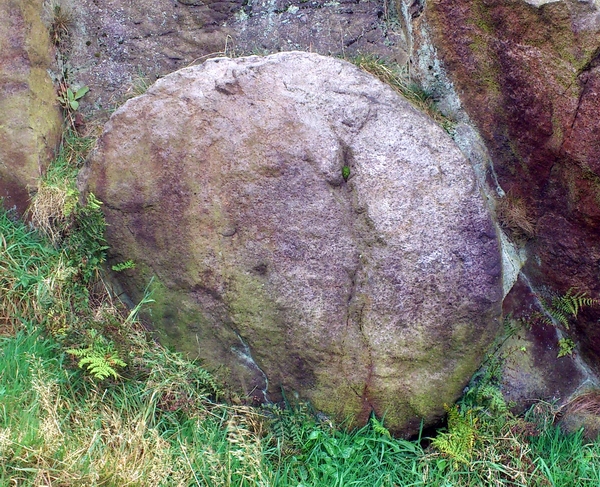
In the photograph on the right you can
see in the center of the partly cut millstone, a mark where an axle hole was
to be chiseled. This stone is at the bottom of the steps to the rear of the
Castle. Two millstones each weighing approximately
25cwt (1300kg) were attached to the end of a timber spar, this was then hauled
away by mules to a finishing block.
In 1923 Joe
Lovatt purchased most of the quarries and proceeded to clear up the old
rubble piles and quarry new rock, mainly for the purpose of road building,
this resulted in a legal wrangle with locals and only lasted a few years.
The deeds for the land including the Castle were handed over to the National
Trust in 1937.
Even though Lovatt's large quarrying company had now finished on Mow Cop,
there were other smaller quarry firms.
Charles Hancock and his son and 2 son in laws, Roger Lancaster and Cyril Baddeley
formed the quarrying company
"Lancaster Hancock & Baddeley" in 1935.
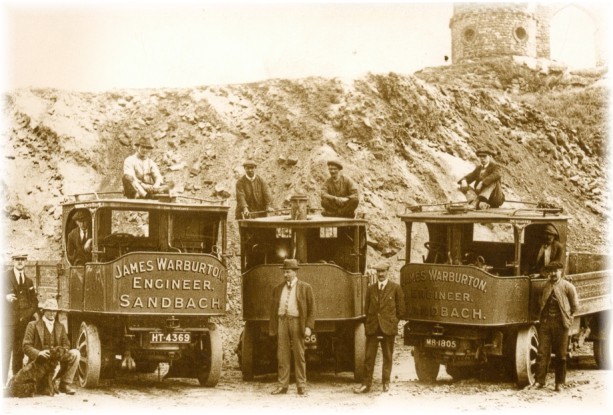
Charles company owned all the land around the Old Man O'Mow but not the Old Man itself, he owned the quarries along Rockside and behind Woodcocks' Well School . The stone was quarried by hand using sledge hammers and metal wedges, then hand mauled into 1 of 4 wagons. They owned 2 Dennis's a Bedford and a brand new Federal. This stone like that of many years before was used for road making in Cheshire.
Glimpses of the old quarrying can be clearly seen as you walk around Mow. There are several partly cut millstones, which were left unfinished for some reason, dark rounded shadows can be made out and radiating tool marks, more examples of these can be found at the base of the Old Man O’Mow. Plug and feather marks can also be seen as well as marks from when blasting was used.
Types of quarrying used on Mow Cop
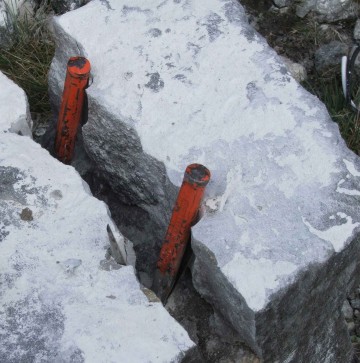
Plug & feather, a line of holes are drilled into the rock & 2 tapered D sectioned "feathers" are inserted into each hole. A tapered wedge (the "plug"), is then inserted between each pair of feathers. The plugs are gradually and evenly hammered home until the rock splits along the line of holes. This is a superb method of producing stone of the size & shape required & is still used today for producing dimensional stone. When used thus it leaves a characteristic line of short, fairly close spaced 1/2 holes on the cut face. However P&F's can also be used in single or maybe a couple of holes, just to break of a lump that's "in th' road". In this case it can be difficult to spot which method was used.
Lime Blasting,
lime is tamped into holes drilled in the rock, moistened with water and
left over night. During which time the lime swells and so splits the rock.
This method leaves quite large 1/2 holes 2-3" diameter and maybe 2ft long,
this was used in some quarries along Mow edge. Apparently the rock could
be heard groaning & creaking during the night before finally splitting!
Black powder blasting, the Mow stuff seen uses hole 12-18"ish long
& around 1" diameter around 1/3 - 1/2 of the hole was filled with powder,
the remaining stemmed with clay, before firing. There are some super examples
of this in the "cave" in the edge at the top of Ganny. One in particular
still contains the stemming & there is soot blackening around the toe of
the hole. There are also good examples in the Mow tunnel. Black powder is
also good for producing dimensional stone as is has a much less shattering
effect than high explosive blasting. Indeed it continues to be used today
on stone such as marble. This was used at Dales Green quarry (Stone
Hole) Bill Hancock recalls his mothers house being hit and damaged by
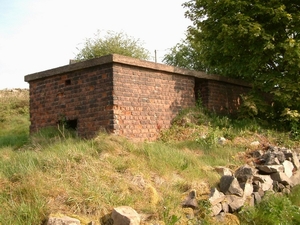
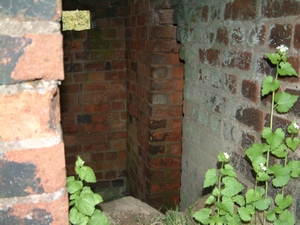
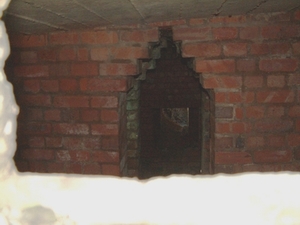
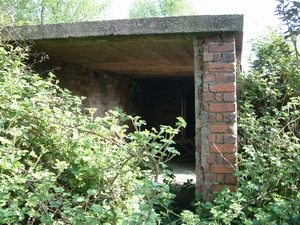
flying rocks caused by this type of blasting. There are at least 2 blast
shelters in the area. The best example is along the paths past Rockside
behind Stone Hole. The other is along Fords Lane
behind The Ash Inn, this is not in such good condition, as the inner walls
have all been removed.
 Plug and Feathers