




Woodcock

|
||||||||
|
Woodcock |
||||||||
|
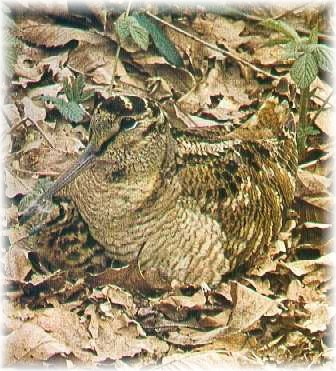
The Woodcock is a large relative of the Snipe is the only bird in the big family of waders to have adapted completely to woodlands. In the winter it may be flushed from damp hollow or rivulet in beech, oak or mixed woods. It occasionally calls out on rising, but it usually rises silently and, like a partridge, very suddenly from almost underfoot. It weaves away, jinking' from side to side, the manoeuvre which makes it hard even for a good shot to hit. As it flies it shows red-brown at each side of its fanned tall, then, when out of range of shot, clear of the trees, it may circle over the wood, a tubby bird with its long bill prominent, at a downward angle, and with broad wings. Woodcock are seen best when they circle their large territory at remarkably regular intervals towards dusk and at dawn. This peculiar flight is called 'roding' and occurs from March to July. The bird flies well above the trees with a slow wing-beat and every now and again it hesitates and gives a croaking call before or after a high pitched double note which carries far. The combined call is 'tissick, tissick, grrrk-grrrk.' Woodcock feed mostly at dusk and dawn, probing soft mud for worms with their long bill, which has a sensitive expanded tip. They nest on the ground in bramble, bracken and general tangle under trees in oak, mixed or pine woods all over Britain. Nests should not be sought, for if disturbed before the eggs are hatched, the birds will desert them readily. If they are hatched, however, and the nest is disturbed even slightly, the parent birds carry the young away one by one held between the legs in a low flight. In October many Woodcock arrive here from northern Europe for the winter. | |||||||
|
|
|
|
|
|
|
|
|